



Home
For me and my friends

Understand Bitcoin, buy it and keep it yourself.

Personal coaching for beginners, couples, families and friends.

Offer

What do you need?

How I work

I share knowledge and help with the technology. I give no personal buy recommendations and do not broker financial products. What and how much you buy is your own decision.

Your words stay with you

You enter recovery words, passphrase and device password only on your own device. I never see them, and no one reputable asks for them. Check unknown providers on the FINMA warning list.

Knowledge

Briefly explained.

14 learning cards on money, Bitcoin and custody. Tap and understand in one minute.

Objections, answered honestly

“Bitcoin uses too much electricity.”Depends on the source

Bitcoin uses about 0.5 % of the world's electricity, just over half of it emission-free. Miners can work anywhere and seek the cheapest power, often stranded energy: unsold hydro, wind and solar power, or gas that would otherwise be flared. Surplus thus becomes network security.

Source: Cambridge Centre for Alternative Finance (2025), Cambridge Bitcoin Electricity Consumption Index; course materials CAS Bitcoin Economy & Blockchain, HWZ (2026) · As of April 2025

“Bitcoin has no intrinsic value.”Falls short

It is true that Bitcoin pays no interest or dividends. But the same applies to gold and cash. Their value comes from their properties and from the fact that others accept them. The market sets how high it is, through supply and demand.

Source: Menger (1871), Grundsätze der Volkswirtschaftslehre

“The price fluctuates far too much.”True

Bitcoin fluctuates more than a broad stock index or gold. You can manage this through position size and time horizon. For private savers, that means: keep it small and only invest money that can stay put for a long time. In the renewal fund, everything short-term stays in Swiss francs.

Source: Felber (2026), HWZ certificate thesis, ch. 2.2.4; course materials CAS Bitcoin Economy & Blockchain, HWZ (2026)

“Bitcoin is a Ponzi scheme.”Not true

A Ponzi scheme has an operator who promises returns and pays earlier investors with the money of new ones. Bitcoin has no operator, promises nothing, and its code is open for anyone to see. That the price can fall does not change this.

Source: Nakamoto (2008), Bitcoin: A Peer-to-Peer Electronic Cash System

“Bitcoin is only for criminals.”Not true

Every payment is public and permanently visible. Senders and recipients appear as addresses that can often be linked to people with analysis tools. For hiding things, that is a poor choice.

Let's talk.

Free, no-obligation initial consultation bitpoint.schweiz@gmail.com
Knowledge

In detail.

Stage 1

Understand

History
15 August 1971

On this day the dollar's link to gold ended. Since then our money has been fiat money, from the Latin for “let it be”. Its value rests on trust in the state and the central bank.

BarterCommodity moneyCoinsBanknotesFiat money1971Bitcoin2009

Source: Ammous (2018), The Bitcoin Standard

Monetary policy
First come, first served

New money does not reach everyone at the same time. Those who get it early still buy at old prices. Those who come late pay the new ones. Savers with a long horizon are at the end of the line.

Drops: purchasing power that arrivesNew moneyEarlyLateSavers

Source: Cantillon effect, after Ammous (2018), The Bitcoin Standard

Economics
21 million

There will never be more Bitcoin than that. Every 210'000 blocks, roughly every four years, the amount of new Bitcoin is halved. The rule is in the open code and anyone can verify it.

New bitcoin per block50200925201212.520166.2520203.1252024

Source: Nakamoto (2008); Bitcoin Core, source code (validation.cpp)

Energy
Energy as a seal of authenticity

Every block costs electricity. Anyone who wants to change an old block must redo this work for it and for all the blocks that follow. Like a wall: swap a stone at the bottom, and you rebuild everything above it.

Energynew blockEach block sits on the one before.

Source: Nakamoto (2008), section Proof-of-Work

Stage 1: Understand

How money works, how Bitcoin works and why Bitcoin is different from other cryptocurrencies.

Stage 2

Implement

Technology
Offline

A hardware wallet keeps your keys separate from the internet. Signing happens inside the device. Always check the address and amount on its display, not only on the computer.

12 wordsSeedPrivateKeyPublicKeybc1q…Addressfor receivingThe path only goes this way.
Risks and limits
Check first, then deposit

“I have the words” is not enough. Check the backup with the check in the app and compare the words on the device before any money is on the wallet. The manufacturer advises against resetting the device as a test.

Devicewith youBackupat a second placeInstructionswith a trusted personStore separately, test the recovery.

Source: BitBox Support, Shift Crypto AG (as of 5 November 2026) · As of November 2026

Legal
Pseudonymous, not anonymous

Every payment is publicly visible. Use each address only once and keep your purchase receipts. Banks and brokers ask where the money came from when you later switch back to Swiss francs.

One address for everythingA new one every timebc1q…all linked and visiblenot linked
Stage 2: Implement

Set up a broker, start using your own hardware wallet, secure and test the backup. You do every step yourself, I guide you.

Stage 3

Use with confidence

Economics
Same amount, every month

With a savings plan you buy regularly for the same amount, at high and at low prices. This creates an average price, and the timing of your entry matters less.

Priceyour average pricethe same amount every month

Source: Felber (2026), HWZ certificate thesis, Appendix D (dollar-cost averaging)

Technology
Size, not amount

The fee for a payment depends on its data size and on how urgent it is. Whether you send 50 or 50'000 francs makes no difference. If you can wait, you pay less.

Data sizeWeight, not contenturgentmore expensivenormalcan waitcheaper
Construction
Foundation and upper floor

Bitcoin stays deliberately simple and robust, like a foundation. Fast, small payments run one floor higher, over Lightning. Only the opening and closing of a channel end up on the blockchain.

BApplicationsLightningpay fastBitcoinsettle, secureSimple foundation, build on top.

Source: Poon and Dryja (2016), The Bitcoin Lightning Network

Stage 3: Use with confidence

Order types, savings plan and signing payments securely. After that, you move your Bitcoin on your own.

Price

One-to-one coaching

Economics
120 CHF per hour

For one person. Expect two to four hours, spread over the three stages. You decide how deep we go and where we stop.

120 CHF per hour1 person · about 2 to 4 hours

Source: Blockfundament, prices

Technology
3 stages

Understand, implement, use with confidence. At the end you have a broker and your own hardware wallet with a checked backup, and you can sign payments yourself.

12 wordsSeedPrivateKeyPublicKeybc1q…Addressfor receivingThe path only goes this way.

Source: Blockfundament, offer

Risks and limits
Knowledge, not a recommendation

I explain how Bitcoin works and how to handle it safely. Whether and how much you buy is up to you. The coaching is no investment, tax or legal advice.

I explainhow Bitcoin workshow to store it safelyYou decidewhether you buyhow much and when

Source: Blockfundament, offer (FAQ)

One-to-one coaching, 120 CHF per hour

In the initial consultation we clarify where you stand and what you need. There is no obligation.

Price

Team coaching

Economics
160 CHF per hour

For two people, for example as a couple or as business partners. Expect three to four hours.

160 CHF per hour2 people · about 3 to 4 hours

Source: Blockfundament, prices

Risks and limits
Two know more

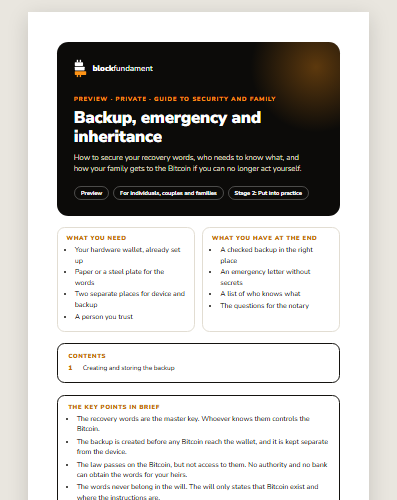
If one person is unavailable, the other must be able to get to the Bitcoin. That is why at least a second person knows where the device and backup are. This includes an emergency letter that contains neither the words nor the password.

Devicewith youBackupat a second placeInstructionswith a trusted personStore separately, test the recovery.

Source: BitBox Support, Shift Crypto AG (as of 5 November 2026); course materials CAS Bitcoin Economy & Blockchain, HWZ (2026)

Who decides
Four eyes

If you hold Bitcoin together, you define who may do what: who holds the keys, who signs and where the emergency letter is kept. We clarify this before any money is on the wallet.

2 of 3
Team coaching, 160 CHF per hour

You learn together and set up your custody so that both of you can handle it.

Price

Group coaching

Economics
200 CHF per hour

For three to eight people, about four hours. Suitable for families, friends or a small team that wants to get started together.

200 CHF per hour3 to 8 people · about 4 hours

Source: Blockfundament, prices

History
From barter to Bitcoin

We start with money itself: barter, commodity money, coins, banknotes, fiat money. Once you know this development, you understand which question Bitcoin answers.

BarterCommodity moneyCoinsBanknotesFiat money1971Bitcoin2009

Source: Menger (1871), Grundsätze der Volkswirtschaftslehre

Energy
About 0.5 %

That is Bitcoin's share of global electricity consumption. Just over half of it is emission-free. We discuss such objections openly in the group, with figures instead of opinions.

Powerreal costsComputing workProof of WorkSecurityhard to fake

Source: Cambridge Centre for Alternative Finance (2025), Cambridge Bitcoin Electricity Consumption Index · As of April 2025

Group coaching, 200 CHF per hour

Tell me how many of you there are and what you want to know. I put the program together for you.

Price

Hardware and accessories

Economics
200 to 380 CHF

That is the cost of the hardware wallet, a steel plate for the backup and the BitBox protective case. You can order them yourself or at a discount through me.

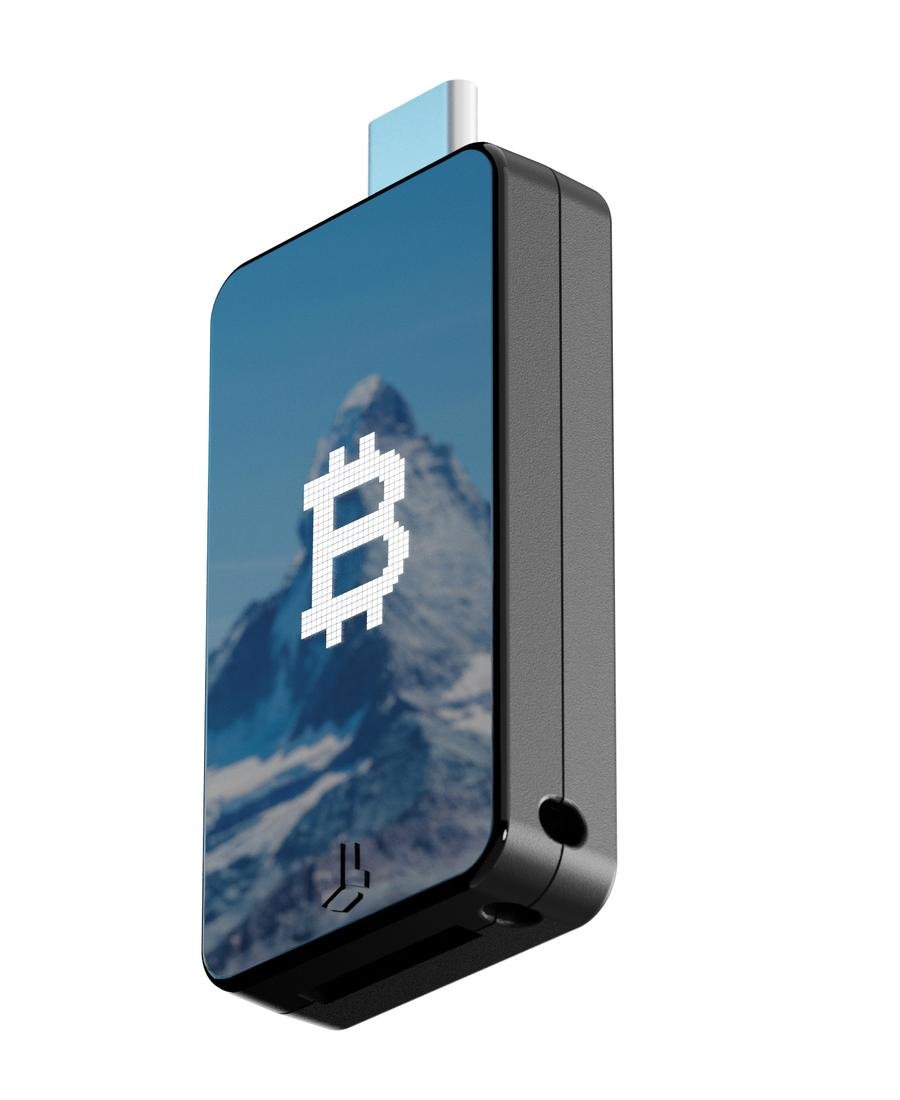
Hardware walletKeys offlineSteel platebackup of the wordsProtective casefor the device

Source: Blockfundament, prices

Technology
Open and verifiable

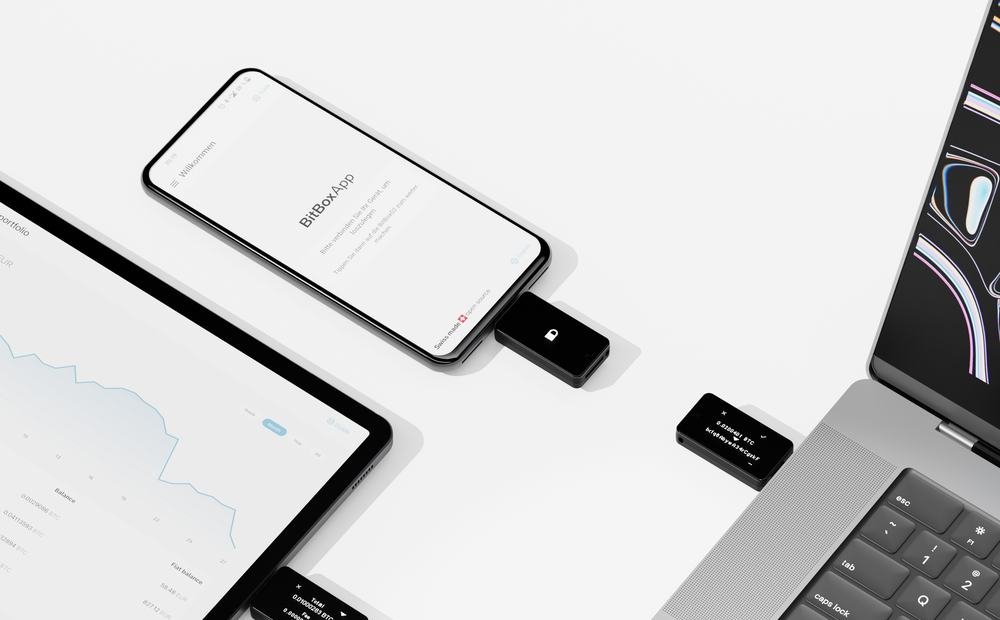
The BitBox comes from Shift Crypto AG in Zurich. Its software is open source, there is a Bitcoin-only edition, and it is also suitable for custody with multiple keys.

BitBoxMaker in ZurichOpen-source softwareBitcoin-only editionSuitable for multiple keys

Source: Shift Crypto AG, manufacturer information; course materials CAS Bitcoin Economy & Blockchain, HWZ (2026)

Risks and limits
Steel instead of paper

Depending on the product, steel resists damage better than paper. But the backup remains a single object in a single place, and anyone who finds it can read it. If you use multiple keys, also mix device manufacturers.

Maker ADevice 1Maker ADevice 2Maker BDevice 3No single fault hits all keys.

Source: BitBox Support, Shift Crypto AG (as of 5 November 2026); course materials CAS Bitcoin Economy & Blockchain, HWZ (2026)

Hardware with setup

You get the device from me and we set it up together right away in the coaching.

Learning card

How money works

Money is more than notes and coins. It is a system of trust, law and debt. Once you understand it, you also understand which question Bitcoin answers.

Economics
3 functions

Money serves as a medium of exchange, a unit of account and a store of value. The franc fulfills the first two very well. For the third, inflation decides how well it works over decades.

ExchangepayCountcompare pricesStoresave for later

Source: Menger (1871), Grundsätze der Volkswirtschaftslehre

Monetary policy
Credit creates money

Most of our money is bank deposits. They are created when a bank grants a loan and disappear again when it is repaid. But will they ever be repaid?

Bank grants a loan: both arise at onceLoanDepositclaim of the banknew money for the customerWhen the loan is repaid, both disappear.
History
Changing anchors

The history of money is a history of changing anchors of trust: first the metal itself, then the promise to redeem paper for metal, today the state with its central bank.

BarterCommodity moneyCoinsBanknotesFiat money1971Bitcoin2009
Stage 1: Understand

In the coaching, we go through the topic of money using examples from your everyday life.

Learning card

From seashells to fiat money

From barter to commodity money and precious metals to today's currencies: the form of money has changed again and again, but its job has stayed the same.

History
4 eras

It started with barter. Then came commodity money such as seashells, later gold and silver, and finally state currencies. Each stage made trade easier.

BarterCommodity moneyCoinsBanknotesFiat money1971Bitcoin2009

Source: Menger (1871), Grundsätze der Volkswirtschaftslehre

Monetary policy
Less metal, more coins

Rulers called in coins, lowered their metal content and issued them again. They kept the profit, and the coin's purchasing power fell. Monetary policy and public finances were linked even back then.

Same coin, less precious metalearlierlater
Economics
Loosened step by step

At first, gold coins circulated. Then paper could only be redeemed for bars, then only by central banks. Since 1971, there has been no redemption at all.

Coinsfor everyoneBarsfor big playersReservescentral banks1971no redemption

Source: Ammous (2018), The Bitcoin Standard

Group coaching

The history of money is the starting point when you come as a group.

Learning card

Hard money

The Austrian School calls money hard if its supply is difficult to expand. For gold, the cost of mining ensures this; for Bitcoin, a fixed rule in the code.

Economics
Nature, politics, code

The amount of gold is limited by the effort of mining it. The amount of francs is steered by the Swiss National Bank and the banks. The amount of Bitcoin is set by a public schedule that no one can change alone.

Goldextraction effortFranccentral bankBitcoinrule in the code

Source: Ammous (2018), The Bitcoin Standard

Technology
More computers, not more Bitcoin

If the gold price rises, more gold is mined. With Bitcoin, that is not possible: when computing power is added, only the difficulty rises. The amount of new Bitcoin stays on schedule.

New bitcoin per block50200925201212.520166.2520203.1252024

Source: Nakamoto (2008), Bitcoin: A Peer-to-Peer Electronic Cash System

Risks and limits
Scarce does not mean stable

The fixed supply says nothing about tomorrow's price. Because supply does not respond, every change in demand hits the price in full. That is why Bitcoin fluctuates strongly.

PriceQuantityFixed supplyDemand beforeDemand afterPrice jumps

Source: Felber (2026), certificate thesis HWZ, ch. 2.2.3 and 2.2.4

Stage 1: Understand

We clarify what scarcity can and cannot do before you invest a single franc.

Learning card

Cantillon effect

Named after the economist Richard Cantillon. The effect explains why a growing money supply does not affect everyone equally and why savers with a long horizon lose the most.

Monetary policy
First come, first served

New money enters the economy at one point. Whoever stands there still buys at old prices. By the time it has reached everyone, prices have risen.

Drops: purchasing power that arrivesNew moneyEarlyLateSavers

Source: Cantillon effect, after Ammous (2018), The Bitcoin Standard

Economics
Distribution, not just inflation

Money creation does not simply make everything more expensive evenly. It shifts prices and wealth between groups. Those who hold real assets are usually better off than those who hold cash or deposits.

Those who are earlybuy at old pricesbenefitThose who are latepay the new priceslose purchasing power
Risks and limits
Savers are at the back

Whoever saves for decades and keeps their money in an account is the late recipient and bears the loss of purchasing power. This applies to private savers as much as to a community's renewal fund.

Drops: purchasing power that arrivesNew moneyEarlyLateSavers

Source: Felber (2026), certificate thesis HWZ, ch. 2.2.2

Stage 1: Understand

I show you, or your community, what the effect means for your own savings.

Learning card

Inflation and purchasing power

If prices rise faster than your account earns interest, the same amount buys less and less. This hits private savers and renewal funds alike. In everyday life it stays invisible, because the account balance keeps growing.

History
CHF 64'600

That is the purchasing power left from 100'000 francs from 1986, measured by consumer prices. The franc is stable, but it too loses value over the decades.

Purchasing power of 100'000 francs1986100'000 CHFtoday64'600 CHF

Source: Bundesamt für Statistik, Landesindex der Konsumentenpreise · As of around 2024

Economics
Construction: 116.2 points

That is where the Swiss construction price index stood in October 2025, with October 2020 at 100 points. The index measures actual market prices for construction work and is published twice a year.

80901001101202000201020202026Oct. 2020 = 100Buildings totalRenovation apartment blocksSwiss construction price index

Source: Bundesamt für Statistik (2025), Schweizerischer Baupreisindex im Oktober 2025 · As of October 2025

Construction
At the tender

Often the community only notices the gap when the offers arrive and are well above the fund balance. Then the only option left is a special levy.

Fund balanceQuoteGapSpeciallevy

Source: Felber (2026), certificate thesis HWZ, ch. 2.1.2

Monetary policy
Nominal and real

Nominal means counted in francs, real means measured in purchasing power. A savings account or a fund can grow in nominal terms and shrink in real terms if inflation is above the interest rate.

Account balancenominal: growsPurchasing powerreal: shrinkstodaytodaylaterlater

Source: Felber (2026), certificate thesis HWZ, ch. 1.2 and Appendix D

Stage 1: Understand

For you privately, we work it through with your savings; for a property, with the renewal schedule.

Learning card

Network and nodes

A node is a computer that checks the entire Bitcoin ledger itself. Because there are so many of them, no one can secretly change the rules.

Technology
3 tasks

A node checks every payment, checks every new block and stores the entire history. That way, no one can create invalid Bitcoin, slip in false blocks or change the past.

Usershold the keysNodescheck the rulesMinerorder and secure

Source: Nakamoto (2008), Bitcoin: A Peer-to-Peer Electronic Cash System

Who decides
Verify instead of trust

Miners propose blocks, but the nodes decide whether they are valid. If you run your own node, you check the rules yourself and do not have to rely on anyone.

Minerproposes a blockNodechecks the rulesChainonly valid stays
Pools
Pools have no power over the rules

Six mining pools find around 80 % of all blocks. But a pool only bundles computing power: it can neither change the rules nor spend other people's Bitcoin, because the nodes reject invalid blocks. The machines belong to the miners, who can switch pools at any time.

6 PoolsOthersWho finds the blocks?about 80 %about 20 %

Source: mempool.space, mining statistics · As of July 2026

Stage 1: Understand

Together we look live into a block and into a real payment.

Learning card

Mining and energy

Miners arrange payments into blocks and have to perform computing work to do so. The electricity use is not an accident, but the price for a history that cannot be forged.

Energy
Energy as a seal of authenticity

Every block costs electricity. Anyone who wants to change an old block has to redo the work for it and for all following blocks. The more computing power in the network, the more expensive an attack.

Energynew blockEach block sits on the one before.

Source: Nakamoto (2008), section Proof-of-Work

Technology
Rolling dice, not calculating

Miners try billions of numbers until one fits. It is like rolling dice: no attempt brings you closer to the goal. Roughly every ten minutes, someone gets lucky. The difficulty adjusts continuously.

Each try is new. None brings you closer.missmissmissHitWhoever hits may write the next block.

Source: Nakamoto (2008), section Proof-of-Work

Economics
60 to 90 % electricity

That is the share of electricity in a miner's running costs. That is why miners look for the cheapest power, often surpluses that no one else needs.

Powerreal costsComputing workProof of WorkSecurityhard to fake
Construction
Using waste heat

A miner gives off almost all of its electricity as heat. It therefore makes sense where electric heating is used anyway: in the water heater, in the greenhouse or for space heating.

BPowerWaste heat warmsBitcoin
Workshop for teams

For businesses with their own energy or a need for heat, we take a closer look at the topic.

Learning card

Lightning

The Bitcoin blockchain is built for secure settlement, not for your morning coffee. Lightning is a second layer on top of it, where payments arrive in seconds.

Technology
Like running a tab at the bar

Two parties open a channel and pay back and forth in it as often as they like. Only the opening and the final settlement end up on the blockchain.

many payments in the channel, no entryOpenon the blockchainClosefinal settlement

Source: Poon and Dryja (2016), The Bitcoin Lightning Network

Construction
Foundation and upper floor

Bitcoin deliberately stays simple and robust as the foundation. Whatever needs to be fast is built one floor higher. That way, nothing has to change in the foundation.

BApplicationsLightningpay fastBitcoinsettle, secureSimple foundation, build on top.
Risks and limits
For small amounts, not for savings

Lightning is suited to small everyday amounts. Savings belong in cold storage. That applies to you privately, and the draft regulations explicitly exclude Lightning for the renewal fund.

Lightningsmall amountsfor everyday useCold storageSavings and reservesoffline, with backup

Source: Felber (2026), certificate thesis HWZ, Appendix C, Art. 6; course materials CAS Bitcoin Economy & Blockchain, HWZ (2026)

Stage 3: Use with confidence

If you like, you make your first Lightning payment during the coaching.

Learning card

Keys and addresses

You can give an address to anyone, like an IBAN. The private key is like your access to e-banking: whoever has it can dispose of the funds.

Technology
One-way street

The public key is calculated from the private key, and the address from the public key. There is no way back. That is why you can share your address without worry.

12 wordsSeedPrivateKeyPublicKeybc1q…Addressfor receivingThe path only goes this way.

Source: Antonopoulos (2017), Mastering Bitcoin

Risks and limits
Whoever has the key

Every payment is signed with the private key. If it falls into someone else's hands, they can send the Bitcoin to themselves. There is no chargeback.

Keyprivate and secretSignaturefor this paymentNetworkchecks and records
Legal
One address, one payment

All payments to an address are publicly visible. If you use the same address several times, you reveal your balance and payment behavior. That is why modern wallets create a new one every time.

One address for everythingA new one every timebc1q…all linked and visiblenot linked
Stage 2: Implement

You generate your keys yourself and see how addresses are created from them.

Learning card

Self-custody

Self-custody means holding your own keys without a bank or exchange. It gives you full control and hands you full responsibility.

Economics
Asset instead of claim

On an exchange, you have a claim to Bitcoin. If it fails, you stand in line with the creditors. With your own key, there is no counterparty.

Your own keyBank or exchangeYou hold the value yourself.Risk: your custodyYou hold a claim.Risk: the counterpartyWho holds the key?

Source: Felber (2026), certificate thesis HWZ, ch. 2.2.3

Technology
Hot or cold

An app on your phone is convenient but always online. A hardware wallet keeps the keys offline and is suited to everything you hold for longer.

App on the phonealways onlinehandy for small amountsHardware walletKeys offlinefor savings
Who decides
Own and verify

Bitcoin stays independent as long as enough people hold their keys themselves and check the rules themselves. Whoever hands everything over to service providers also gives up this voice.

Usershold the keysNodescheck the rulesMinerorder and secure
Stage 2: Implement

We set up your hardware wallet until you feel confident with it.

Learning card

Seed backup

If the device breaks, you restore everything with the seed. If the seed falls into someone else's hands, the Bitcoin are gone. That is why the backup matters more than the device.

Technology
2048 words

That is the length of the list the words come from. Twelve of them give so many possibilities that guessing is practically impossible. All keys are derived from the seed.

12 wordsSeedPrivateKeyPublicKeybc1q…Addressfor receivingThe path only goes this way.

Source: Bitcoin Improvement Proposal BIP39

Risks and limits
Store separately

The seed belongs on paper or steel, never in a photo or a cloud. Store it separately from the device and check the backup before any money is on the wallet.

Devicewith youBackupat a second placeInstructionswith a trusted personStore separately, test the recovery.

Source: Felber (2026), certificate thesis HWZ, Appendix C, Art. 6

Who decides
Instructions for your heirs

Write down where everything is and in which order to proceed. A trusted person knows where the instructions are, but not the words. Ideally, you go through it together once.

This belongs in the instructionsWhat is where?In what order to proceed?Who knows the place?Practiced together once?
Stage 2: Implement

Create, store and check the backup: we do it together.

Learning card

Multisig

Multisig spreads control across multiple keys. A payment is only valid once a set number of them have signed. You know this from a bank account with joint signature.

Technology
2 of 3

The most common form: three keys, two must sign. One may be lost, one may be stolen, and the money still stays safe and accessible.

2 of 3

Source: Antonopoulos (2017), Mastering Bitcoin

Risks and limits
Name the threat first

Burglary, dispute, coercion or a forgotten storage place: each threat calls for a different distribution. Three keys in the same house protect against none of them.

Maker ADevice 1Maker ADevice 2Maker BDevice 3No single fault hits all keys.
Construction
Built for failure

A structure is designed to hold even if one part fails. Multisig follows the same idea: plan for failure instead of hoping it never happens.

One support fails.The beam still holds.Key 1lostKey 3
Setting up multisig

For couples, businesses and communities, I plan the distribution and guide you through the setup.

Learning card

Savings plan

Instead of waiting for the right moment, you buy for the same amount every month. Sometimes you get more Bitcoin, sometimes less. Over time, this results in an average price.

Economics
Same amount, every month

When the price is low, you automatically buy more; when it is high, less. No one has to watch the market or make decisions based on gut feeling.

Priceyour average pricethe same amount every month

Source: Felber (2026), certificate thesis HWZ, Appendix D (dollar-cost averaging)

Risks and limits
Smooths, does not protect

A savings plan only spreads out the entry. The price can still stay lower for a long time afterwards: in the past, Bitcoin has lost more than half its value several times.

Priceyour average pricePrice today: below itbought every month

Source: Felber (2026), certificate thesis HWZ, ch. 2.2.4

Who decides
Rule instead of gut feeling

In the renewal fund, the savings plan is mandatory: the amount is decided together with the budget, and no one may decide on buying or selling times at their own discretion.

How buying worksFixed amountEvery monthApproved with the budgetNo discretion on timing

Source: Felber (2026), certificate thesis HWZ, Appendix C, Art. 1 and 4

Stage 3: Use with confidence

We set up your savings plan with the broker and clarify when you transfer to your own wallet.

Learning card

Limits and risks

Anyone who explains Bitcoin also has to say what speaks against it. The key points are volatility, custody, open legal questions and its short history.

Risks and limits
Four risks

Loss of the key, an attack on the network, a ban, and reputation. The first three are unlikely but would have major consequences. Against losing your key, you can do the most yourself.

Impact →Probability →12341 Key loss2 51 % attack3 Ban4 Reputation
Monetary policy
The franc is strong

In countries with high inflation, the benefit of Bitcoin is obvious. In Switzerland, the loss of purchasing power is smaller, and the risk of price swings weighs correspondingly heavier.

BenefitsmallerVolatilityweighs moreThe more stable the franc, the smaller the benefit.

Source: Felber (2026), certificate thesis HWZ, ch. 2.2.4

Technology
Software has bugs

In August 2010, a bug created billions of Bitcoin out of nothing. It was fixed within hours and the faulty chain discarded. The network corrected itself, but it is not free of errors.

2010Calculation bugfixed in 5 hours2013Chain split24 blocks long2018Security flawnever exploited

Source: Bitcoin vulnerability CVE-2010-5139

An honest initial consultation

Bring your doubts. We go through them one by one.

Beginners

I want to get started

For everyone who wants to understand Bitcoin first. No jargon, at your own pace. Whether and how much you buy is up to you.

How we proceed

  1. Initial consultationWe clarify where you stand and what you need. No obligation.
  2. How money worksWhere money comes from and why its purchasing power declines.
  3. How Bitcoin worksKeys, nodes and mining, explained so that you can pass it on.
  4. Bitcoin and cryptoWhy Bitcoin is different from other cryptocurrencies.
  5. Spotting scamsNo one legitimate asks for your recovery words. Not even support.
  6. What nextYou decide how deep we go and whether you continue with implementing.

What you take away

  • You understand how money and Bitcoin work
  • You know the risks: Bitcoin is young and its price fluctuates
  • You recognize the most common scams
  • You know the steps to your own wallet

Framework

Format
One-to-one coaching, stage 1 of 3
Duration
Two to four hours for all three stages
Price
120 CHF per hour
You need
No prior knowledge
Not included
Buying tips, price forecasts, investment advice

Related documents

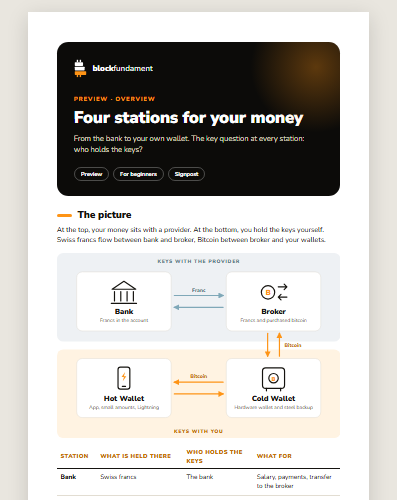
  • Four stations for your money
View previews

Basis: Blockfundament, offer (stage 1) and prices; scam protection: BitBox Support, Shift Crypto AG (as of 5 November 2026)

Stage 1: Understand

Getting started begins with an initial consultation, with no obligation.

Initial consultation
Security

I want self-custody

We set everything up together. You do every step yourself, I guide you. You enter your recovery words only on the device; nobody else sees them.

How we proceed

  1. Set up a brokerOpen an account and place your first purchase as a limit order.
  2. Check and start the deviceCheck the seal, download the app from the manufacturer's site, set the device password on the device.
  3. Create the backupBefore any Bitcoin go onto the wallet. On steel, separate from the device, never photographed.
  4. Check the backupWith the check in the app and by comparing the words on the device.
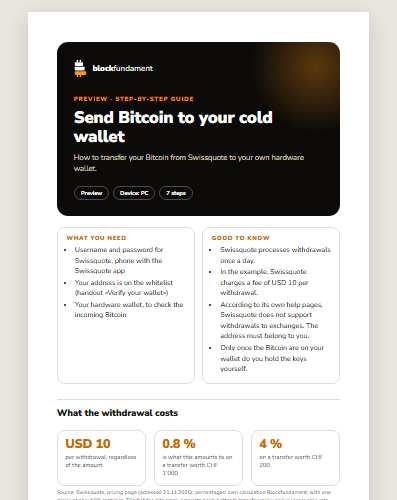
  5. Send to your own walletWhitelist the address at Swissquote, compare it on the device, withdraw, check receipt.
  6. Use with confidenceOrder types, savings plan and signing payments securely.

What you have at the end

  • Cold wallet, hot wallet and steel wallet set up
  • A checked backup, stored separately from the device
  • A broker account that you operate yourself
  • Step-by-step guides for reference

Framework

Format
One-to-one coaching, stages 2 and 3
Duration
Two to four hours for all three stages
Price
120 CHF per hour
Hardware
BitBox with accessories CHF 200 to 380, ordered yourself or at a discount through me
Withdrawal
Swissquote charges a flat 10 USD per withdrawal (as of November 2026)

Related documents

  • Buying Bitcoin at Swissquote (PC and mobile)
  • Verifying the wallet
  • Sending Bitcoin to the cold wallet
  • Wallet of Satoshi in self-custody
View previews

Basis: Blockfundament, offer (stages 2 and 3) and prices; setup and backup: BitBox Support, Shift Crypto AG (as of 5 November 2026); Swissquote, Krypto-Überweisungen

Stages 2 and 3: Implement and use

Hardware through me if you like; we set it up right away in the coaching.

Initial consultation
Family and friends

We want to get started together

As a couple, family or group of friends. You learn together and set up custody so that more than one person can handle it.

How we proceed

  1. Preliminary talkTell me how many of you there are and what you want to know. I put the program together.
  2. Basics togetherFrom barter to Bitcoin: how money came about and which question Bitcoin answers.
  3. Discussing objections openlyElectricity, price swings, crime: with figures instead of opinions.
  4. Setting up custodySo that everyone involved can handle it.
  5. Planning for emergenciesWhere the backup is, who helps, and an emergency letter without secrets, kept separate from the words.

What you have at the end

  • A shared level of knowledge
  • Custody that does not depend on a single person
  • An emergency letter that contains no words and no password
  • Handouts for reference

Framework

For two
160 CHF per hour, three to four hours
Three to eight people
200 CHF per hour, about four hours
Hardware
BitBox with accessories CHF 200 to 380
Scope
Questions of inheritance law are for you to clarify with a notary or lawyer

Related documents

  • Four stations for your money
  • Buying Bitcoin at Swissquote
  • Sending Bitcoin to the cold wallet
View previews

Basis: Blockfundament, prices (team and group coaching); emergency letter: BitBox Support, Shift Crypto AG (as of 5 November 2026)

Preview Save PDF