Home
For condominium owners and property managers

The renewal fund that keeps its purchasing power.

First the renewal plan from the construction manager, then security in francs, only after that a limited share of Bitcoin.

For condominium ownership · from my CAS thesis

The renewal fund on hard money.

How a small share of Bitcoin protects the purchasing power of your reserves without putting the next renovation at risk.

The problem

Building gets more expensive. The savings account does not keep up.

Every building component has an expiry date. If the money is missing then, a special levy follows. Many associations put aside too little.

0.25 %is what associations put aside per year on average
0.8 %would be the benchmark

In % of the building insurance value. Source: Lucerne University of Applied Sciences and Arts (Raiffeisen, 28.04.2026).

Background
The yardstick

Building: plus 16 %. Savings account: plus 2.5 %.

The construction price index rose from 100 to 116.2 points in five years. An account with 0.5 % interest reaches 102.5 in the same period. The association pays for the gap.

Oct. 2020 to Oct. 2025. Source: Federal Statistical Office; savings account with 0.5 % interest.

Background
The solution

Security first. Then Bitcoin.

Whatever is renovated in the next few years stays in francs. Only a small part of the rest goes into Bitcoin.

Background
All renovations in the next 5 to 7 years, plus a reserve
Long-term surplus
Of which a capped share of Bitcoin, via savings plan
The result

Fewer special levies with the same contributions.

Without Bitcoin760'000 CHF
With 5 % Bitcoin708'000 CHF
With 21 % Bitcoin524'000 CHF

Example from the thesis: 10 units, 250 CHF per month, 41 years.

The look-back

Was it worth it? The rule with real prices.

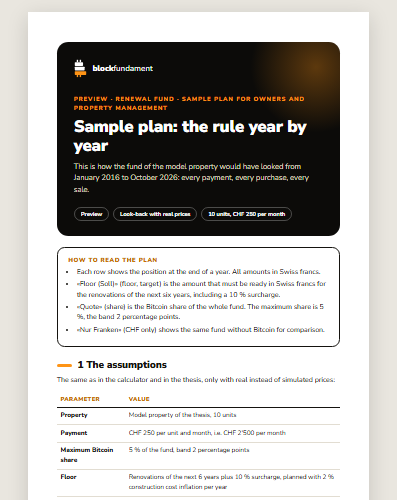
Start in January 2016, as of October 2026: with 325'000 CHF in contributions, the fund with 5 % Bitcoin would stand at around 382'000 CHF, in francs only at 334'000 CHF.

Back-calculation for the model building. The result depends heavily on the start year.

Custody

No one has sole control.

Three keys, two must sign. Set out in the investment regulations, verifiable for the auditor.

Background
2 of 3 multisig
How it works
Suits a classic condominium owners' association (STWEG)Small share, long floor, regulated custody partner.
Suits Bitcoin-minded associationsHigher share and self-custody possible.
Does not suitWith a short renovation horizon or without consensus, the pure CHF fund remains the right choice.See the limits
Calculator

Try it out.

A model calculation for your property.

Adjust all assumptions
Renovations of the coming years stay in francs (floor).
Reserve on top of the floor.
Trades happen only from this deviation on.
Reserve that already exists.
Makes every renovation more expensive.
Interest on the franc part.
Assumed return per year.
How much the price swings.
On the Bitcoin part.
Spread and fee.
–
of the renovations are covered
Special levies without Bitcoin
–
With Bitcoin (typical)
–
Savings
–
With Bitcoin (unfavorable)
–

Fund assets over time

With BitcoinCHF onlyRenovation due

Is there enough money for each renovation?

SurplusShortfall
Entirely without Bitcoin and without a special levy
– CHF per owner and month needed
Currently set: – of that · – CHF per year · Total need –
Enter the building parts of your property
More figures and rebalancing
Fund at the end, with Bitcoin
–
Fund at the end, CHF only
–
Custody and trading costs
–
Paths with no special levy at all
–

Bitcoin share and rebalancing

Bitcoin shareTarget shareSale
Knowledge about the fund

The terms behind it.

9 learning cards and the glossary for the concept. Tap and understand in one minute. The basics of money and Bitcoin are on the page for savers.

Renewal fund glossary

Allocation
Division of the fund's assets among asset classes, here francs and Bitcoin.
Backtest
Retrospective test of an investment rule using historical data.
Bitcoin
Decentralized electronic money system with issuance capped at around 21 million units.
BKP / eBKP-H
Construction cost plan (Baukostenplan) for structuring construction costs by building components and elements.
Building insurance value
Insured value of the building; reference value for the rule of thumb on the annual fund contribution.
Building up the fund (Äufnung)
Planned build-up of the renewal fund through recurring contributions.
Construction cost inflation
Rise in construction prices over time, measured by the construction price index.
Construction price index (Baupreisindex, BPI)
Index of market prices for construction work, collected twice a year by the Federal Statistical Office (October 2020 = 100).
Counterparty risk
Risk that a contracting party, for example a bank, defaults.
Coverage ratio
Ratio of the fund's assets to the inflation-indexed renewal requirement.
CPI (LIK)
Swiss consumer price index (Landesindex der Konsumentenpreise); measures general inflation for consumers.
Drawdown
Decline in value from the last peak.
Drift
Expected average return per unit of time in the simulation.
Fat tails
Distributions with more frequent extreme events than the normal distribution assumes.
Geometric Brownian motion
Standard stochastic model for price paths with constant drift and volatility.
Hard money
Money with high scarcity that is difficult to increase (Austrian School).
Investment regulations (Anlagereglement)
Set of rules adopted by the owners' meeting on share, floor, custody, rebalancing and reporting.
Joint power of attorney (Kollektivbevollmächtigung)
Bank power of attorney under which several persons can only act together.
Liquidity floor
Renewal requirement falling due within the planning horizon, fully covered in francs.
Median
Value that half of the simulation paths exceed and half fall below.
Monte Carlo simulation
Calculating many random future paths to estimate probabilities.
Multisig (multisignature)
Custody with multiple keys; a payment needs a minimum number of signatures, for example 2 of 3.
Nominal / real
Nominal means counted in francs, real means measured in purchasing power, here in construction work.
Percentile
Threshold of a distribution; 90 % of the paths fall below the 90th percentile.
Rebalancing / rebalancing band
Return to the target share; trading only happens when the share leaves the tolerance band.
Renewal fund (Erneuerungsfonds)
Earmarked special fund of the condominium owners' association for renewing shared building components (Art. 712l and 712m ZGB).
Renewal schedule
Schedule of when building components are due, with service lives, costs and renewal dates.
Savings plan (dollar-cost averaging)
Regular purchase for a fixed amount to smooth out the entry point.
Seed
Recovery words of a Bitcoin wallet. In the calculator, seed also means the starting value of the random number generator.
Self-custody
Holding your own keys directly, without a custody service provider.
Sensitivity analysis
Changing individual assumptions to test how stable a result is.
Sequence risk
Risk of having to sell at an unfavorable price at the time of renewal.
Shortfall
At the time of renewal, the assets are not enough for the inflation-indexed requirement.
SIA / SIA service lives
Swiss Society of Engineers and Architects (Schweizerischer Ingenieur- und Architektenverein); reference values for the service life of building components.
Special levy (Sonderumlage, Nachschuss)
Extraordinary contribution by the owners when the fund is not enough.
STWEG / condominium ownership
Condominium owners' association (Stockwerkeigentümergemeinschaft); co-ownership with exclusive rights to parts of the building (Art. 712a ff. ZGB).
Tender (Submission)
Call for tenders and bidding process for awarding construction work.
Value quota (Wertquote)
Share of a unit in the total value of the property; basis for the obligation to contribute (Art. 712h ZGB).
Volatility
Strength of price fluctuations, measured as standard deviation per year.

Let's talk.

Free, no-obligation initial consultation bitpoint.schweiz@gmail.com
Knowledge

In detail.

Condominium ownership

For our property

Construction
8 to 80 years

Every building component has its own service life: the stairwell paint about 10 years, the heating 15 to 20, the facade 30 to 40, the load-bearing structure over 60. This gives the renewal calendar.

020406080Stairwell paintHeatingFloor coveringsElevatorFlat roofPlumbingGroundsElectricalWindowsFacadePitched roofStructureYears

Source: Felber (2026), HWZ certificate thesis, Appendix A (ranges according to BKP/eBKP-H)

Economics
0.4 %

According to the rule of thumb of the Swiss condominium owners' federation, at least this share of the building insurance value should flow into the fund each year. In practice, reserves are often set too low.

Building insurance valueRule of thumb for contributions0.4 % per year into the funddrawn enlarged

Source: Schweizer Stockwerkeigentümerverband (n.d.); Bruni et al. (2010), Bundesamt für Wohnungswesen

Legal
Art. 712l and 712m ZGB

The fund belongs to the condominium owners' association (STWEG). The owners' meeting decides on creating it, paying into it and withdrawing from it. Without its resolution, nothing changes in how the fund is invested.

HeadsOwnership sharesover 50 % in both

Source: Swiss Civil Code (ZGB), Art. 712l Abs. 1 and Art. 712m Abs. 1 Ziff. 5

Renewal fund concept

I survey the building, assess its condition, draw up the renewal plan according to BKP and prepare the documents for the owners' meeting.

The problem

Building is getting more expensive

Construction
2.03 million CHF

That is what twelve renovations over 41 years cost in the model property if construction cost inflation is 2 % a year. At today's prices it would be 1.055 million CHF.

HeatingFlat roofFacade010203040Years from today

Source: Felber (2026), HWZ certificate thesis, Appendix B; renewal fund calculator

Economics
116.2 points

That was the Swiss construction price index (construction total) in October 2025, with 100 points in October 2020. Since October 2000, building has become about 37 % more expensive, most sharply between 2020 and 2022. A low-interest account cannot keep pace.

80901001101202000201020202026Oct. 2020 = 100Buildings totalRenovation apartment blocksSwiss construction price index

Source: Bundesamt für Statistik (2026), Schweizerischer Baupreisindex, Indexwerte pro Objekttyp, October 1998 to April 2026 (table of 18.06.2026) · As of October 2025

Monetary policy
116.2 versus 102.5

From October 2020 to October 2025, construction prices rose from 100 to 116.2 points. An account with 0.5 % interest grows to 102.5 in five years. The balance is nominally safe, but in real terms buys less construction work.

October 2020 = 100, as of October 2025100Construction prices (total)116.2Savings account, 0.5 % interest102.5Gap: 13.7 points

Source: Bundesamt für Statistik (2025), Schweizerischer Baupreisindex im Oktober 2025; Felber (2026), HWZ certificate thesis, ch. 1.2 and Appendix B · As of October 2025

Renewal calendar for your property

As a construction manager, I survey the building, assess its condition and draw up the schedule of building components according to BKP. This is worthwhile even without Bitcoin.

The solution

Security first, then Bitcoin

Economics
Two pots

The floor covers all renovations of the coming years and is held in Swiss francs. Only what goes beyond it may flow into Bitcoin, and only up to the approved maximum share.

Floor in CHFRest in CHFnext renovationsSurplusBTCat most q

Source: Felber (2026), HWZ certificate thesis, ch. 2.3.1

Construction
5 to 7 years

That is how far ahead the floor looks. What the renewal calendar shows in this window stays in Swiss francs, plus a margin for the uncertainty of the cost estimate. The window moves forward every year.

Horizon, e.g. in year 13HeatingFlat roofFacade010203040Years from today

Source: Felber (2026), HWZ certificate thesis, ch. 2.3.1 and Appendix C, Art. 2

Risks and limits
Never under deadline pressure

The roofer's invoice arrives on a fixed date, while the price fluctuates. Because the money for upcoming renovations is held in Swiss francs, the association never has to sell Bitcoin at a low.

Floor in francsInvoice duePrice at a lowTime

Source: Felber (2026), HWZ certificate thesis, ch. 2.1.3

Renewal fund concept

We set the floor, horizon and maximum share for your property and record them in a draft of the investment regulations (Anlagereglement).

The result

Fewer special levies

Economics
51'000 CHF less

That is how much the special levies fall in the model property with 5 % Bitcoin in the typical scenario. That is about 5'000 CHF per owner. With 21 %, they are 236'000 CHF lower.

Without Bitcoin760'000 CHFWith 5 %708'000 CHFWith 21 %524'000 CHF

Source: Felber (2026), HWZ certificate thesis, ch. 2.3.7; renewal fund calculator

Risks and limits
10'000 CHF more

That is how much higher the special levies are with 5 % Bitcoin in the unfavorable case. With 21 %, they are 64'000 CHF higher. The calculation assumes a 12 % return and 40 % volatility per year. This is a model, not a forecast.

Special levies in 1000 CHFwithout Bitcoin: 760With 5 %708770With 21 %524824left: typical caseright: unfavorable case

Source: Felber (2026), HWZ certificate thesis, ch. 2.3.7

Construction
Year 35

Until then, in the model, all renovations are covered in the typical scenario, with 5 % as with 21 % Bitcoin. The benefit shows in the late, large items such as the facade in year 38.

HeatingFlat roofFacade010203040Years from today

Source: Felber (2026), HWZ certificate thesis, ch. 2.3.7

Go through the calculator together

We enter the building components of your property and look at what different shares and contributions mean for you.

The look-back

Was it worth it?

Over time
382'000 instead of 334'000 CHF

Back-calculation with real prices for the model property, starting January 2016: by October 2026, 325'000 CHF had been paid in. With 5 % Bitcoin, the fund would be at about 382'000 CHF, in Swiss francs only at 334'000, with 21 % at 597'000 CHF.

Fund assets in CHF, January 2016 to October 2026Francs only5 % Bitcoin21 % Bitcoin0200k400k600k201620182020202220242026597'000382'000334'000Paid in: 325'000 CHF. k = 1000 CHF, end values rounded.

Source: Own back-calculation based on Felber (2026), HWZ certificate thesis, ch. 2.3.2. Prices: blockchain.com and Europäische Zentralbank. Construction prices: Bundesamt für Statistik · As of October 2026

5 %
+48'000 CHF

Start 2016 with at most 5 % Bitcoin: +48'000 CHF compared with the pure Swiss franc fund, as of October 2026. Start 2020: +11'000 CHF. Start 2025: −300 CHF. Largest interim decline of the fund since 2016: 4.4 %.

With 5 % Bitcoin: more or less than with francs onlyStart 2016+48'000 CHFStart 2017+35'000 CHFStart 2018+23'000 CHFStart 2019+16'000 CHFStart 2020+11'000 CHFStart 2021+5'100 CHFStart 2022+3'500 CHFStart 2023+1'600 CHFStart 2024+500 CHFStart 2025−300 CHFAs of October 2026, model building, same contributions.

Source: Own back-calculation based on Felber (2026), HWZ certificate thesis, ch. 2.3.2. Prices: blockchain.com and Europäische Zentralbank. Construction prices: Bundesamt für Statistik · As of October 2026

10 %
+102'000 CHF

Start 2016 with at most 10 % Bitcoin: +102'000 CHF compared with the pure Swiss franc fund, as of October 2026. Start 2020: +21'000 CHF. Start 2025: −200 CHF. Largest interim decline of the fund since 2016: 10.0 %.

With 10 % Bitcoin: more or less than with francs onlyStart 2016+102'000 CHFStart 2017+70'000 CHFStart 2018+51'000 CHFStart 2019+36'000 CHFStart 2020+21'000 CHFStart 2021+13'000 CHFStart 2022+9'100 CHFStart 2023+3'700 CHFStart 2024+500 CHFStart 2025−200 CHFAs of October 2026, model building, same contributions.

Source: Own back-calculation based on Felber (2026), HWZ certificate thesis, ch. 2.3.2. Prices: blockchain.com and Europäische Zentralbank. Construction prices: Bundesamt für Statistik · As of October 2026

15 %
+169'000 CHF

Start 2016 with at most 15 % Bitcoin: +169'000 CHF compared with the pure Swiss franc fund, as of October 2026. Start 2020: +33'000 CHF. Start 2025: −200 CHF. Largest interim decline of the fund since 2016: 14.6 %.

With 15 % Bitcoin: more or less than with francs onlyStart 2016+169'000 CHFStart 2017+114'000 CHFStart 2018+76'000 CHFStart 2019+55'000 CHFStart 2020+33'000 CHFStart 2021+18'000 CHFStart 2022+12'000 CHFStart 2023+5'600 CHFStart 2024+600 CHFStart 2025−200 CHFAs of October 2026, model building, same contributions.

Source: Own back-calculation based on Felber (2026), HWZ certificate thesis, ch. 2.3.2. Prices: blockchain.com and Europäische Zentralbank. Construction prices: Bundesamt für Statistik · As of October 2026

21 %
+263'000 CHF

Start 2016 with at most 21 % Bitcoin: +263'000 CHF compared with the pure Swiss franc fund, as of October 2026. Start 2020: +50'000 CHF. Start 2025: −600 CHF. Largest interim decline of the fund since 2016: 20.4 %.

With 21 % Bitcoin: more or less than with francs onlyStart 2016+263'000 CHFStart 2017+170'000 CHFStart 2018+112'000 CHFStart 2019+78'000 CHFStart 2020+50'000 CHFStart 2021+25'000 CHFStart 2022+18'000 CHFStart 2023+8'700 CHFStart 2024+800 CHFStart 2025−600 CHFAs of October 2026, model building, same contributions.

Source: Own back-calculation based on Felber (2026), HWZ certificate thesis, ch. 2.3.2. Prices: blockchain.com and Europäische Zentralbank. Construction prices: Bundesamt für Statistik · As of October 2026

From look-back to outlook

The look-back shows what was. For what could come next, the calculator runs 500 possible paths. I go through both with your renewal plan.

Custody

Nobody has sole control

Technology
2 of 3

There are three keys, and two must sign together. If one is lost, the fund remains accessible. If one is stolen, it is not enough on its own.

2 of 3

Source: Antonopoulos (2017), Mastering Bitcoin

Legal
Like a bank account

You know the multiple-approval principle from joint signing authority (Kollektivvollmacht). The draft regulations require: no household with more than one key, one key with an independent party, view-only access without control for the auditor.

ManagementKey 1CommitteeKey 2Independent partyKey 3Audit: sees everything, can move nothing.

Source: Felber (2026), HWZ certificate thesis, Appendix C, Art. 6 and 7

Risks and limits
Built for failure

The number of keys determines how many may be lost. The number of signatures determines how hard misuse is. If all keys are in the same place, neither helps.

Maker ADevice 1Maker ADevice 2Maker BDevice 3No single fault hits all keys.
Set up and test multisig

I guide property management and the committee through the setup, the distribution of the keys and the recovery test.

The limits

When it does not fit

Risks and limits
Total loss possible

The Bitcoin price fluctuates strongly, and in the worst case the position can become worthless. There is no deposit insurance. That is why the floor stays in Swiss francs and the share is capped.

Floor in CHFRest in CHFnext renovationsSurplusBTCcan be lost in the worst case

Source: Felber (2026), HWZ certificate thesis, ch. 2.2.4 and Appendix C, Art. 9

Monetary policy
The Swiss franc is strong

The Swiss franc has held its value over long periods, at times with very low or negative inflation. The smaller the loss of purchasing power, the smaller the benefit of adding Bitcoin.

BenefitsmallerVolatilityweighs moreThe more stable the franc, the smaller the benefit.

Source: Felber (2026), HWZ certificate thesis, ch. 2.2.4 and 3.3

Who decides
No agreement: no

If the next major renovation is imminent or the association is divided, a pure Swiss franc fund remains the right choice. The concept needs discipline and people who stand behind it.

Major renovation soon?Association agreed?Consider the conceptCHF fundCHF fundyesnonoyes

Source: Felber (2026), HWZ certificate thesis, management summary and ch. 3.3

An honest initial consultation

We first check whether the concept suits your property. If it does not, I will tell you.

Price

Renewal fund concept

Construction
Three steps on the building

I survey the building on site, assess its condition and draw up the renewal plan with the schedule of building components according to BKP. This is the basis for the floor and good practice for any association anyway.

Surveybuilding on siteAssessmentbuilding fabricRenewal plandates by BKP

Source: Felber (2026), HWZ certificate thesis, ch. 3.2 and Appendix A; offer Blockfundament

Economics
500 paths

The calculator runs 500 possible price paths for your property and shows how often the money is sufficient and how high the special levies turn out. All assumptions are open and can be changed.

Without Bitcoin760'000 CHFWith 5 %708'000 CHFWith 21 %524'000 CHF

Source: Felber (2026), HWZ certificate thesis, ch. 2.3.6; renewal fund calculator

Legal
10 articles

That is the length of the draft investment regulations: purpose, floor, maximum share, purchases, withdrawals, custody, responsibilities, report, risks, exit. Your legal advisor adapts it.

HeadsOwnership sharesover 50 % in both

Source: Felber (2026), HWZ certificate thesis, Appendix C

Renewal fund concept, price on request

Building survey, assessment of the building's condition, renewal plan according to BKP, calculation and draft regulations. The effort depends on size and condition.

How it works

Six steps

Resolution
Double majority

The owners' meeting approves the investment regulations, maximum share and floor horizon. This requires a majority of the owners who also represent more than half of the ownership shares (Wertquoten).

HeadsOwnership sharesover 50 % in both

Source: Swiss Civil Code (ZGB), Art. 712g Abs. 3; Felber (2026), HWZ certificate thesis, Appendix C, Art. 10

Multisig
Test first

The keys are distributed, and no household holds more than one. Before any money flows, a recovery is run through with a small amount.

ManagementKey 1CommitteeKey 2Independent partyKey 3Audit: sees everything, can move nothing.

Source: Felber (2026), HWZ certificate thesis, ch. 2.3.5 and Appendix C, Art. 6

Saving
Fixed amount

What goes beyond the floor is pooled and converted into Bitcoin every month with a fixed amount. Purchased Bitcoin move into the joint wallet at least monthly.

Priceyour average pricethe same amount every month

Source: Felber (2026), HWZ certificate thesis, ch. 2.3.5 and Appendix C, Art. 4 and 6

Rebalancing
Only outside the band

Property management checks the floor and share regularly. Action is taken only when the share leaves the agreed band: above it, Bitcoin is sold; below it, more is bought in stages.

above: sellbelow: buy moreBandTarget shareInside the band, nothing happens.

Source: Felber (2026), HWZ certificate thesis, Appendix C, Art. 4

Topping up
Early, not in the last month

As a major renovation approaches, contributions go entirely into Swiss francs. If that is not enough, funds are shifted in tranches. Payments are made exclusively from Swiss francs.

Horizon, e.g. in year 13HeatingFlat roofFacade010203040Years from today

Source: Felber (2026), HWZ certificate thesis, ch. 2.3.1 and Appendix C, Art. 4 and 5

Report
Everything on the table

Property management reports every year on holdings, share, floor, transactions, costs and the recovery test. The auditor checks holdings and compliance with the rules.

The annual report showsHoldings and shareFloor: target and actualTransactions and costsRecovery test

Source: Felber (2026), HWZ certificate thesis, Appendix C, Art. 8

Support through all six steps

I guide property management and the committee from the resolution to the first annual report.

Learning card

Hard money

The Austrian School calls money hard if its supply is difficult to expand. For gold, the cost of mining ensures this; for Bitcoin, a fixed rule in the code.

Economics
Nature, politics, code

The amount of gold is limited by the effort of mining it. The amount of francs is steered by the Swiss National Bank and the banks. The amount of Bitcoin is set by a public schedule that no one can change alone.

Goldextraction effortFranccentral bankBitcoinrule in the code

Source: Ammous (2018), The Bitcoin Standard

Technology
More computers, not more Bitcoin

If the gold price rises, more gold is mined. With Bitcoin, that is not possible: when computing power is added, only the difficulty rises. The amount of new Bitcoin stays on schedule.

New bitcoin per block50200925201212.520166.2520203.1252024

Source: Nakamoto (2008), Bitcoin: A Peer-to-Peer Electronic Cash System

Risks and limits
Scarce does not mean stable

The fixed supply says nothing about tomorrow's price. Because supply does not respond, every change in demand hits the price in full. That is why Bitcoin fluctuates strongly.

PriceQuantityFixed supplyDemand beforeDemand afterPrice jumps

Source: Felber (2026), certificate thesis HWZ, ch. 2.2.3 and 2.2.4

Stage 1: Understand

We clarify what scarcity can and cannot do before you invest a single franc.

Learning card

Inflation and purchasing power

If prices rise faster than your account earns interest, the same amount buys less and less. This hits private savers and renewal funds alike. In everyday life it stays invisible, because the account balance keeps growing.

History
CHF 64'600

That is the purchasing power left from 100'000 francs from 1986, measured by consumer prices. The franc is stable, but it too loses value over the decades.

Purchasing power of 100'000 francs1986100'000 CHFtoday64'600 CHF

Source: Bundesamt für Statistik, Landesindex der Konsumentenpreise · As of around 2024

Economics
Construction: 116.2 points

That is where the Swiss construction price index stood in October 2025, with October 2020 at 100 points. The index measures actual market prices for construction work and is published twice a year.

80901001101202000201020202026Oct. 2020 = 100Buildings totalRenovation apartment blocksSwiss construction price index

Source: Bundesamt für Statistik (2025), Schweizerischer Baupreisindex im Oktober 2025 · As of October 2025

Construction
At the tender

Often the community only notices the gap when the offers arrive and are well above the fund balance. Then the only option left is a special levy.

Fund balanceQuoteGapSpeciallevy

Source: Felber (2026), certificate thesis HWZ, ch. 2.1.2

Monetary policy
Nominal and real

Nominal means counted in francs, real means measured in purchasing power. A savings account or a fund can grow in nominal terms and shrink in real terms if inflation is above the interest rate.

Account balancenominal: growsPurchasing powerreal: shrinkstodaytodaylaterlater

Source: Felber (2026), certificate thesis HWZ, ch. 1.2 and Appendix D

Stage 1: Understand

For you privately, we work it through with your savings; for a property, with the renewal schedule.

Learning card

Self-custody

Self-custody means holding your own keys without a bank or exchange. It gives you full control and hands you full responsibility.

Economics
Asset instead of claim

On an exchange, you have a claim to Bitcoin. If it fails, you stand in line with the creditors. With your own key, there is no counterparty.

Your own keyBank or exchangeYou hold the value yourself.Risk: your custodyYou hold a claim.Risk: the counterpartyWho holds the key?

Source: Felber (2026), certificate thesis HWZ, ch. 2.2.3

Technology
Hot or cold

An app on your phone is convenient but always online. A hardware wallet keeps the keys offline and is suited to everything you hold for longer.

App on the phonealways onlinehandy for small amountsHardware walletKeys offlinefor savings
Who decides
Own and verify

Bitcoin stays independent as long as enough people hold their keys themselves and check the rules themselves. Whoever hands everything over to service providers also gives up this voice.

Usershold the keysNodescheck the rulesMinerorder and secure
Stage 2: Implement

We set up your hardware wallet until you feel confident with it.

Learning card

Seed backup

If the device breaks, you restore everything with the seed. If the seed falls into someone else's hands, the Bitcoin are gone. That is why the backup matters more than the device.

Technology
2048 words

That is the length of the list the words come from. Twelve of them give so many possibilities that guessing is practically impossible. All keys are derived from the seed.

12 wordsSeedPrivateKeyPublicKeybc1q…Addressfor receivingThe path only goes this way.

Source: Bitcoin Improvement Proposal BIP39

Risks and limits
Store separately

The seed belongs on paper or steel, never in a photo or a cloud. Store it separately from the device and check the backup before any money is on the wallet.

Devicewith youBackupat a second placeInstructionswith a trusted personStore separately, test the recovery.

Source: Felber (2026), certificate thesis HWZ, Appendix C, Art. 6

Who decides
Instructions for your heirs

Write down where everything is and in which order to proceed. A trusted person knows where the instructions are, but not the words. Ideally, you go through it together once.

This belongs in the instructionsWhat is where?In what order to proceed?Who knows the place?Practiced together once?
Stage 2: Implement

Create, store and check the backup: we do it together.

Learning card

Multisig

Multisig spreads control across multiple keys. A payment is only valid once a set number of them have signed. You know this from a bank account with joint signature.

Technology
2 of 3

The most common form: three keys, two must sign. One may be lost, one may be stolen, and the money still stays safe and accessible.

2 of 3

Source: Antonopoulos (2017), Mastering Bitcoin

Risks and limits
Name the threat first

Burglary, dispute, coercion or a forgotten storage place: each threat calls for a different distribution. Three keys in the same house protect against none of them.

Maker ADevice 1Maker ADevice 2Maker BDevice 3No single fault hits all keys.
Construction
Built for failure

A structure is designed to hold even if one part fails. Multisig follows the same idea: plan for failure instead of hoping it never happens.

One support fails.The beam still holds.Key 1lostKey 3
Setting up multisig

For couples, businesses and communities, I plan the distribution and guide you through the setup.

Learning card

Sequence risk

An investment can do well over decades and still be low at the wrong moment. This affects anyone who needs money on a fixed date: private savers before buying a home, just as much as a fund before a renovation.

Risks and limits
Selling at the low

If a major renovation coincides with a price drop, the community would have to sell at the worst moment. The loss would then be final.

Floor in francsInvoice duePrice at a lowTime

Source: Felber (2026), certificate thesis HWZ, ch. 2.1.3

Construction
The dates are fixed

A flat roof lasts 20 to 30 years, a heating system 15 to 20. When the bill will come is largely known. The only unknown is where the price will be then.

HeatingFlat roofFacade010203040Years from today

Source: Felber (2026), certificate thesis HWZ, ch. 2.1.3 and Appendix A

Economics
Ruled out, not predicted

No one can predict the price on the due date. The solution is therefore not a forecast but a design: money for upcoming renovations is never put into Bitcoin in the first place.

Floor in CHFRest in CHFnext renovationsSurplusBTCat most q

Source: Felber (2026), certificate thesis HWZ, ch. 2.1.3 and 2.3.1

Renewal fund concept

We check how soon your next renovations are due and what that means for the investment.

Learning card

Liquidity floor rule

The floor is the amount the renovations of the coming years will cost, plus a margin. It is held entirely in francs. Bitcoin is only an option for the surplus.

Economics
Two pots

The Bitcoin share is capped twice: never more than the surplus above the floor and never more than the maximum share of the whole fund that has been decided.

Floor in CHFRest in CHFnext renovationsSurplusBTCat most q

Source: Felber (2026), certificate thesis HWZ, ch. 2.3.1

Construction
The window moves along

Every year, the horizon moves one year further. When a major renovation enters the window, contributions first go entirely into francs. If that is not enough, funds are shifted early and in tranches.

Horizon, e.g. in year 13HeatingFlat roofFacade010203040Years from today

Source: Felber (2026), certificate thesis HWZ, ch. 2.3.1

Legal
Anchored in the regulations

The draft investment regulations state: the floor is held exclusively in francs, in accounts of the community at banks in Switzerland, taking deposit protection into account.

The floor is heldonly in francsin accounts of the associationat banks in Switzerlandwithin deposit insurance

Source: Felber (2026), certificate thesis HWZ, Appendix C, Art. 2

Renewal fund concept

We set the horizon, margin and maximum share for your property.

Learning card

Renewal schedule

Building components are structured according to the construction cost plan (BKP), recorded with their service life and today's costs, and projected to the year of renewal. This shows when how much money must be available.

Construction
12 building components

From the paint in the stairwell to heating, elevator and windows, all the way to the structure: the template covers twelve items with typical service lives. A specialist enters the values for your property.

020406080Stairwell paintHeatingFloor coveringsElevatorFlat roofPlumbingGroundsElectricalWindowsFacadePitched roofStructureYears

Source: Felber (2026), certificate thesis HWZ, Appendix A; CRB, Baukostenplan BKP and eBKP-H

Economics
Almost double

In the model property, the renovations cost CHF 1.055 million today. Projected to the respective year with 2 % construction cost inflation, this becomes CHF 2.03 million.

HeatingFlat roofFacade010203040Years from today

Source: Felber (2026), certificate thesis HWZ, Appendix B

Who decides
Update every year

A specialist draws up the plan, the property management updates it every year, and the owners' meeting approves it. That way it stays current when condition or prices change.

Expertdraws up the planManagementupdates it yearlyMeetingapproves

Source: Felber (2026), certificate thesis HWZ, Appendix C, Art. 2

Renewal schedule for your property

I survey the building on site, assess the building fabric and draw up the schedule according to BKP with you.

Learning card

Limits and risks

Anyone who explains Bitcoin also has to say what speaks against it. The key points are volatility, custody, open legal questions and its short history.

Risks and limits
Four risks

Loss of the key, an attack on the network, a ban, and reputation. The first three are unlikely but would have major consequences. Against losing your key, you can do the most yourself.

Impact →Probability →12341 Key loss2 51 % attack3 Ban4 Reputation
Monetary policy
The franc is strong

In countries with high inflation, the benefit of Bitcoin is obvious. In Switzerland, the loss of purchasing power is smaller, and the risk of price swings weighs correspondingly heavier.

BenefitsmallerVolatilityweighs moreThe more stable the franc, the smaller the benefit.

Source: Felber (2026), certificate thesis HWZ, ch. 2.2.4

Technology
Software has bugs

In August 2010, a bug created billions of Bitcoin out of nothing. It was fixed within hours and the faulty chain discarded. The network corrected itself, but it is not free of errors.

2010Calculation bugfixed in 5 hours2013Chain split24 blocks long2018Security flawnever exploited

Source: Bitcoin vulnerability CVE-2010-5139

Preview Save PDF